Research
Connecting data-driven learning to knowledge, causality, verifiable reasoning, and reliable decisions.
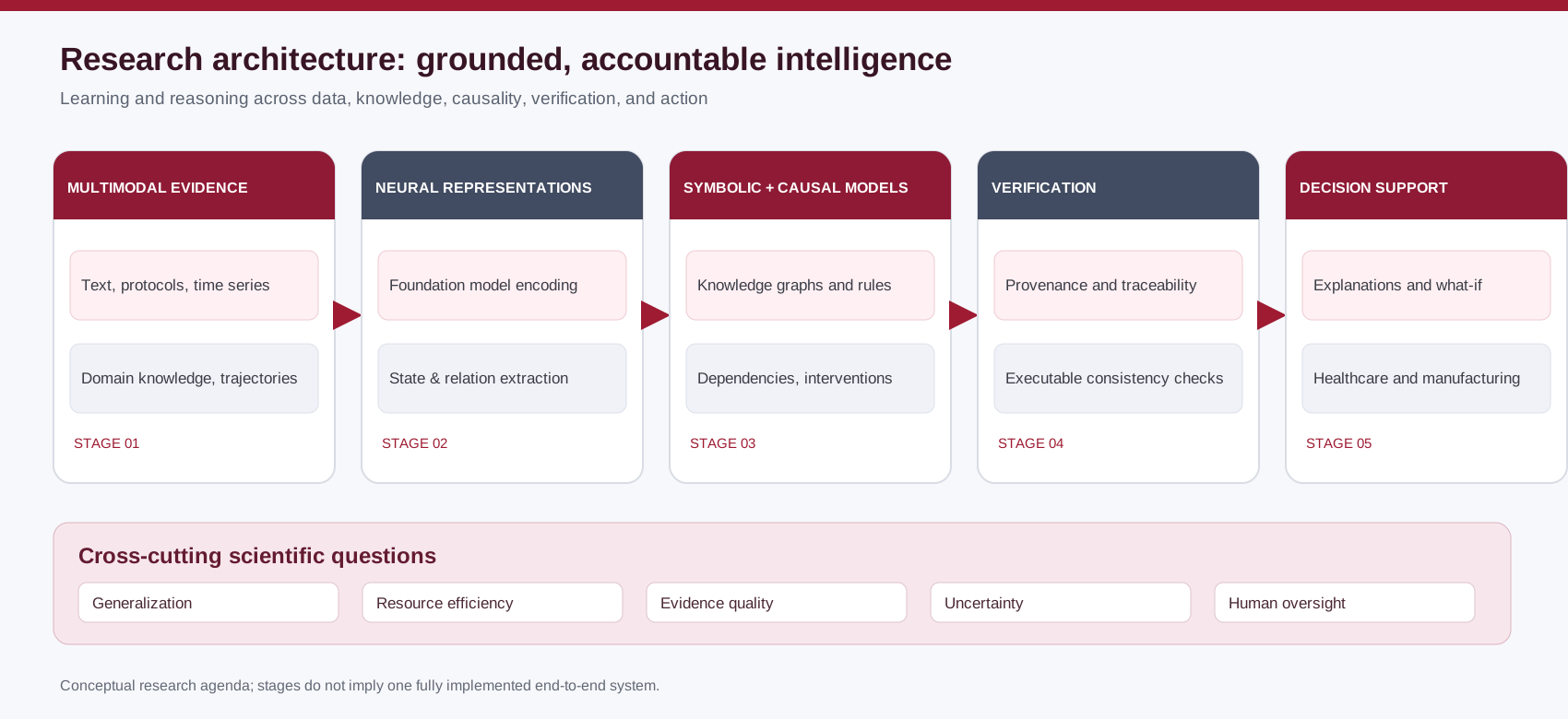
My research asks a central question: How can we build AI systems whose behavior can be grounded in knowledge and processes, inspected, and improved—rather than judged solely by predictive accuracy? The work spans machine learning foundations and deployable AI systems, with rigorous evaluation in real applications.
RESEARCH PILLAR 01
Neurosymbolic AI & knowledge integration
Injecting declarative constraints, domain processes, and structured representations into neural learning and inference.
RESEARCH PILLAR 02
Agentic reasoning & verifiability
Evidence-grounded tool use, executable reasoning artifacts, procedural checks, and transparent decisions.
RESEARCH PILLAR 03
Causal and sequential decision-making
Understanding transitions, dependencies, interventions, and decision quality over time.
RESEARCH PILLAR 04
Responsible AI in high-stakes domains
Process-aligned clinical and manufacturing decision support, with attention to explanations and real-world constraints.
Current research directions
Process-grounded reasoning
A document, procedure, or observed trajectory may encode more than descriptive facts: it can imply states, constraints, dependencies, and possible actions. We study ways to recover and use those structures, evaluate what can be verified, and expose uncertainty when the evidence is insufficient.
Reliable, auditable AI agents
LLM-based agents can act on external systems, but plausible rationales are not sufficient evidence of correct execution. We explore architectures that separate proposed decisions from evidence checks, structural constraints, and independent verification.
Neurosymbolic and causal learning
Our research combines learned representations with symbolic formalisms and causal understanding, aiming for models that generalize across changing settings while retaining inspectable decision logic.
Healthcare and scientific applications
Healthcare process evaluation and diagnostic support motivate much of this work. For example, our NeSy 2026 sepsis study combines semantic normalization with expert-defined fuzzy rules to assess protocol adherence; our ACM healthcare article examines LLM-assisted mental health assessment.
Selected projects and research threads
- BRAINS Lab affiliation: Interdisciplinary research in bioinspired robotics, AI, imaging and neurocognitive systems at UA. BRAINS Lab.
- Process-grounded learning: Work emerging from the 2025 doctoral dissertation, Process-Grounded Knowledge-Infused Learning and Decision Making.
- Reproducible LLM evaluation: In-Situ Eval, presented in the AAAI 2026 Demonstration Track.
- Cognitive neurosymbolic systems: The IEEE Intelligent Systems article on foundation models, cognitive architectures, and knowledge.
Collaboration: I welcome cross-disciplinary conversations about interpretable learning, agents, planning, healthcare AI, and manufacturing. For research inquiries, please get in touch.